
In every society, memory must find a form if it is to survive. Some cultures write their histories in books how to spot fake nike dunks. Others carve them into wood, cast them in bronze, weave them into fabric, or sing them into rhythm. Across Africa, heritage has rarely been static. It has been danced, sculpted, recited, painted, and performed. It has lived in motion.
Art, in this sense, is not decorative. It is archival.
Where archives store documents, art stores emotion. Where textbooks preserve facts, art preserves feeling. And feeling is often what ensures continuity between generations.
In contemporary Uganda, especially within historically rich regions such as the Bunyoro-Kitara Kingdom, visual art has increasingly become a powerful bridge between ancestral memory and modern identity. Murals, portraits, commemorative installations, and reflective paintings are doing more than beautifying walls. They are reclaiming narrative space.
They are becoming living canvases.
When Paint Becomes Memory
Every generation inherits stories. But not every generation understands them in the same way. Oral traditions, once the primary vessel of cultural transmission, now compete with digital media, global entertainment, and fast-paced urban life. As attention spans shorten and cultural exposure diversifies, heritage must adapt its language.
Visual art offers that adaptation.
A painting can compress centuries into a single frame. It can portray struggle, resilience, dignity, and transformation in a way that invites contemplation rather than instruction. It can provoke questions that textbooks cannot.
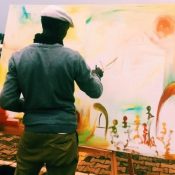
In recent years, youthful artists have stepped into this space not merely as creators, but as interpreters of history. Among them is Roland Tibirushya, a visual artist whose reflective cultural and commemorative works have contributed to heritage-centered initiatives and events. His portraits and large-scale pieces do not attempt to recreate the past mechanically. They reinterpret it thoughtfully for the present.
“Art allows us to hold history without freezing it,” Tibirushya reflects. “When I paint cultural figures or historical moments, I am not only honoring what happened. I am asking young people to see themselves inside that story — to recognize that heritage is not behind them; it is within them.”
That insight captures the essence of intergenerational transmission. Heritage is sustained not when it is admired from a distance, but when it is internalized.
The Artist as Cultural Translator
Historically, custodians of heritage were elders, chiefs, storytellers, and spiritual leaders. Today, artists increasingly share that responsibility. They translate cultural symbols into contemporary visual language. They reframe historical figures for audiences who may never open a history book but will pause before a striking mural.
Through color, symbolism, texture, and expression, artists create entry points into collective memory. A royal portrait becomes more than a likeness. It becomes a conversation starter. A commemorative painting becomes a classroom without walls.
In portraying figures such as Omukama Cwa II Kabalega, artists do more than memorialize a leader. They explore themes of courage, sovereignty, reform, and resistance. They ask what those values mean in a contemporary context shaped by globalization, digital technology, and shifting civic expectations.
This is where art transcends nostalgia. It becomes inquiry Nike Taupe & White Dunk Low Sneakers.
Global Memory, Local Expression
The global importance of memory preservation reinforces this evolving role of artistic expression. Across continents, institutions increasingly recognize that safeguarding memory is fundamental to identity formation and sustainable cultural development. The UNESCO Memory of the World Programme exemplifies this recognition, advancing efforts to protect documentary heritage and ensure its accessibility for future generations.
While often associated with manuscripts, archives, and recorded materials, the philosophical foundation of the programme aligns closely with artistic heritage preservation. In societies where memory has historically been transmitted through oral and symbolic forms, visual art operates as a complementary archive — documenting lived experience, commemorating collective milestones, and preserving emotional truths that formal documentation may not fully capture.
Art therefore expands the boundaries of what constitutes documentary heritage.
A commemorative painting becomes a visual record. A mural becomes a narrative map. A symbolic installation becomes a community memory marker. These artistic expressions form accessible archives embedded within everyday environments, enabling heritage to be encountered not only by researchers but by communities themselves.
Youth Engagement Through Creative Expression
One of the most profound shifts in heritage preservation today is the increasing involvement of young creators. For a generation navigating global influences and digital identities, art offers a way to engage culture actively rather than passively.
When young artists reinterpret traditional symbols through modern techniques, they demonstrate that heritage is not fragile. It is flexible. It can absorb new influences without losing its core.
This creative reinterpretation strengthens belonging. It reassures youth that embracing modern tools does not require abandoning ancestral narratives. Instead, the two can coexist.
A painting displayed at a commemorative event, a mural unveiled during a cultural celebration, or an exhibition linked to a memorial lecture does more than decorate a venue. It anchors the event in visual memory. Long after speeches fade, images remain.
Images linger in the mind. They travel through photographs. They circulate online. They become reference points in collective consciousness.
In this way, art extends the lifespan of heritage initiatives.
From Commemoration to Continuity
Heritage preservation often risks becoming episodic — marked by anniversaries, ceremonies, and symbolic dates. While these moments are important, they require continuity to remain meaningful. Artistic expression provides that continuity.
A commemorative painting does not expire when an event concludes. It continues to speak in galleries, offices, schools, and digital platforms. It becomes part of daily visual experience. It normalizes air jordan 13 black flint heritage presence in contemporary spaces.
Roland Tibirushya captures this continuity powerfully: “When a young person adidas Gazelle sneakers stands before a painting of a cultural figure and feels pride instead of distance, that is preservation. That is transmission. The canvas becomes a conversation across time.”
Conversation across time is precisely what intergenerational heritage transmission demands. It requires more than preservation of artifacts. It requires renewal of relevance.
Cultural Infrastructure Through Art
As societies invest in cultural squares, leadership institutes, lecture platforms, and heritage documentation, artistic expression should not be treated as an accessory. It should be embedded as foundational infrastructure.
Art shapes atmosphere. It communicates identity without words. It invites reflection in ways policy documents cannot.
When cultural institutions intentionally commission and support local artists, they create ecosystems where creativity reinforces memory. They signal that heritage is not only studied — it is lived.
Moreover, supporting artists sustains cultural economies. It affirms that heritage preservation is not merely symbolic but economically participatory. Young creatives become stakeholders in cultural continuity, not observers.
Living Heritage for Future Generations
Heritage is often described as something we inherit. But it is equally something we create. Each generation adds brushstrokes to the larger canvas of collective identity.
The question is whether those brushstrokes will deepen cultural continuity or dilute it.
Art provides a way to ensure continuity without rigidity. It honors form while welcoming reinterpretation. It respects origin while inviting innovation.
Living canvases remind us that heritage is not locked in the past. It is painted, repainted, and reimagined in every era.
In a world of accelerating change, perhaps the most powerful way to preserve memory is not to protect it from reinterpretation, but to invite reinterpretation responsibly.
Because when art carries heritage forward, it does more than preserve history.
It keeps it alive.
Art does not simply decorate memory — it carries it forward. How artists are becoming custodians of intergenerational heritage.