
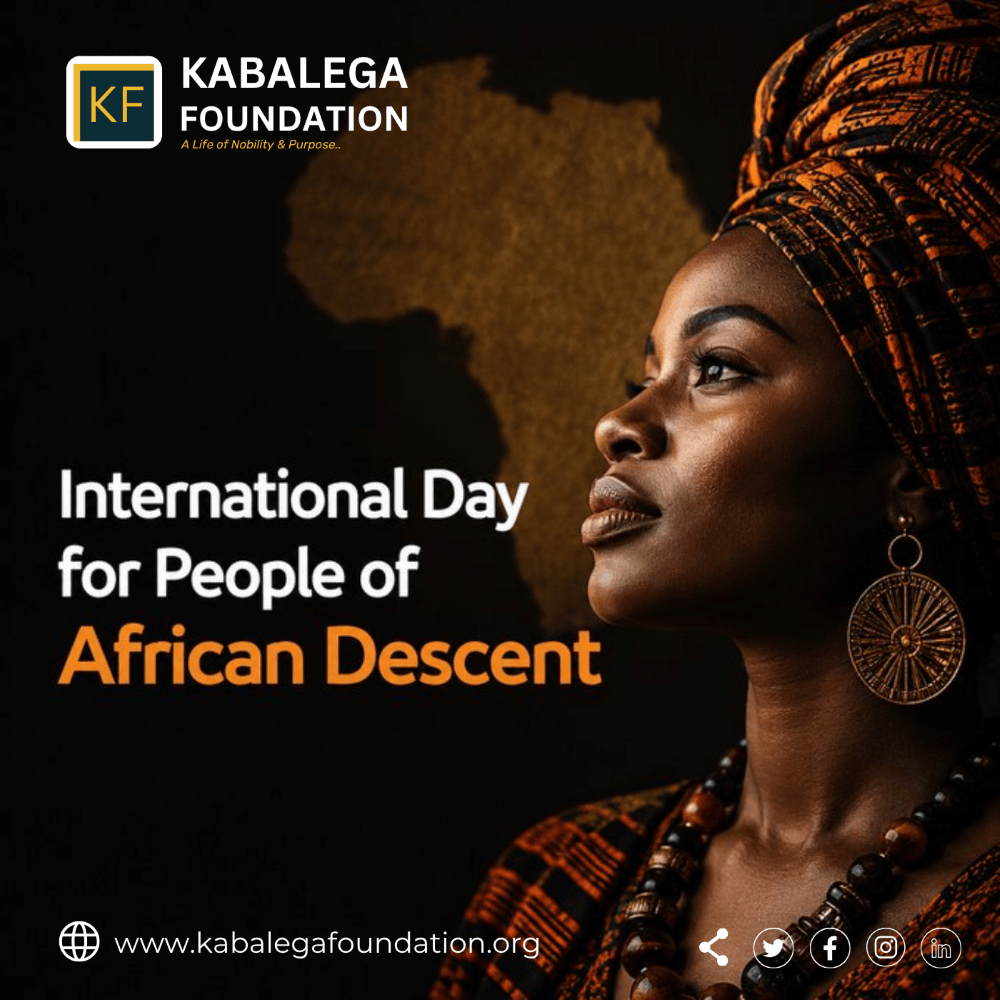
International Day for People of African Descent: Honouring Global Contributions, Confronting Historical Injustices and Advancing Rights
31 August 2026
Every 31 August, the world observes the International Day for People of African Descent, a day dedicated to recognising the immense contributions of people of African descent to human civilisation while confronting the historical and contemporary injustices that continue to shape their lives.
For Kabalega Foundation, this commemoration carries particular significance. It speaks to a central conviction of our work: Africa’s history is not merely a record of the past; it is a foundation upon which dignity, identity, leadership and transformation can be built. The story of people of African descent is therefore not a story of victimhood alone. It is a story of creativity, resistance, resilience, intellectual achievement, cultural continuity and an enduring struggle for freedom and equality.
The United Nations first observed the International Day for People of African Descent on 31 August 2021, with the objective of promoting recognition of the extraordinary contributions of the African diaspora and eliminating discrimination against people of African descent.
In 2026, the observance comes at an important moment. The United Nations has begun the Second International Decade for People of African Descent, 2025–2034, under the theme “People of African Descent: Recognition, Justice and Development.” The new decade builds on the first International Decade, which ran from 2015 to 2024, and places renewed emphasis on transforming recognition into justice and development.
A global African story
The African story did not end at the continent’s shores.
Across the Caribbean, the Americas, Europe, the Middle East and other parts of the world, communities of African descent have carried with them languages, music, spirituality, foodways, artistic traditions, systems of knowledge and forms of social organisation that have profoundly influenced the societies in which they live.
The African diaspora is consequently not simply a consequence of history; it has become one of the most significant cultural and human forces in the modern world. UNESCO estimates that around 200 million people in the Americas identify as being of African descent, while millions more of African heritage live elsewhere outside the African continent.
From the rhythms that shaped modern popular music to literary traditions, political thought, scientific innovation, sport, fashion, entrepreneurship and the arts, people of African descent have made contributions far beyond what conventional historical narratives have often acknowledged.
Their influence can be seen in the intellectual traditions of figures such as W.E.B. Du Bois and Frantz Fanon, the political leadership of figures such as Nelson Mandela and Martin Luther King Jr., the literary achievements of Chinua Achebe, Toni Morrison and Maya Angelou, the scientific contributions of figures such as George Washington Carver and Katherine Johnson, and the cultural influence of generations of African and Afro-descendant artists, musicians, entrepreneurs and innovators.
These achievements should not be understood as isolated stories of exceptional individuals. They are expressions of communities that have continually created, adapted and contributed despite circumstances that frequently sought to deny their humanity and potential.
Remembering the history behind the struggle
Celebration without historical memory can become superficial.
The history of people of African descent is inseparable from some of humanity’s most profound injustices: the transatlantic slave trade, slavery, colonialism, racial segregation, dispossession and systems of institutional discrimination.
The transatlantic slave trade forcibly displaced millions of Africans and transformed economies, political systems and societies across continents. Its consequences did not disappear with abolition. They continued through colonial structures, racial hierarchies, exclusion from land and economic opportunity, and the marginalisation of African histories and knowledge.
The United Nations recognises slavery, the transatlantic slave trade and colonialism as historical realities whose enduring repercussions continue to affect people of African descent. The organisation has repeatedly stressed the need to acknowledge these histories rather than erase or minimise them.
This is why historical memory matters.
When communities lose control over their history, they can also lose part of their sense of identity and agency. When generations grow up knowing more about European history than about their own African intellectual, political and cultural traditions, a form of historical disinheritance occurs.
For this reason, reclaiming African history is not an exercise in nostalgia. It is an act of empowerment.
UNESCO’s work on the General History of Africa and the Routes of Enslaved Peoples emphasises the importance of research, education, historical memory and accurate representation in challenging stereotypes and ensuring that the history of Africans and people of African descent is properly understood.
From resistance to transformation
Across generations, people of African descent have resisted systems designed to diminish their humanity.
Resistance has taken many forms: political movements, intellectual work, cultural preservation, organised protest, community solidarity, artistic expression, entrepreneurship and the simple determination to preserve identity under extraordinary pressure.
The preservation of African culture itself has often been an act of resistance.
Stories survived. Languages survived. Names survived. Music survived. Religious traditions survived. Indigenous knowledge survived. Food traditions crossed oceans. Oral histories were passed from grandparents to grandchildren. Communities rebuilt themselves in unfamiliar lands while retaining connections to ancestral memory.
UNESCO’s documentation of African and Afro-descendant heritage demonstrates how cultural practices have served as mechanisms of resilience and continuity. African oral traditions, for example, travelled with enslaved Africans and became part of the cultural landscapes of the Caribbean and the Americas.
This resilience continues to shape the modern world.
Yet resilience should never become an excuse for injustice. It is not enough to celebrate the ability of people to overcome discrimination while leaving the structures that produce discrimination intact.
The question before the world is therefore not simply how people of African descent have survived, but why they have had to struggle so hard to secure rights and opportunities that should belong to every human being.
The unfinished struggle for equality
Despite significant progress, racial discrimination remains a global reality.
People of African descent continue to experience disparities in access to education, employment, healthcare, housing, political participation and economic opportunity in different parts of the world. Structural racism can operate through institutions and systems even where explicit racial discrimination is prohibited by law.
The United Nations continues to highlight systemic racism, social inequality, hate speech, exclusion and the digital divide as contemporary barriers facing people of African descent. Its 2026 message also warns against attempts to erase or minimise the historical realities of slavery, colonialism and racism.
The Durban Declaration and Programme of Action, adopted at the 2001 World Conference against Racism in Durban, South Africa, remains an important international framework for confronting racism and racial discrimination. It recognises that systemic discrimination can be embedded within institutions and public policies rather than appearing only through individual acts of prejudice.
This distinction is important.
A society may formally proclaim equality while inequalities continue to be reproduced through unequal access to resources, representation and opportunity. Advancing the rights of people of African descent therefore requires more than condemning racist attitudes. It requires examining the structures that perpetuate exclusion and creating institutions capable of delivering genuine equality.
Recognition must lead to justice
The theme of the second International Decade—Recognition, Justice and Development—offers an important way of understanding what this moment demands.
Recognition means acknowledging the history, identity, cultures and contributions of people of African descent. It means ensuring that African and Afro-descendant histories are accurately represented in education, museums, public institutions and cultural spaces.
Justice means confronting discrimination and addressing the consequences of historical wrongs. It means protecting civil, political, economic, social and cultural rights and ensuring that institutions serve all people equally.
Development means ensuring that recognition and justice translate into tangible improvements in people’s lives: quality education, decent work, entrepreneurship, technological opportunity, access to finance, healthcare, political participation and the ability to shape one’s own future.
The three are inseparable.
Recognition without justice can become symbolic. Justice without development can leave communities trapped in structural disadvantage. Development without recognition can reproduce systems that overlook culture, identity and historical experience.
The goal must therefore be transformative development rooted in dignity, equality and historical consciousness.
Africa and its global diaspora
For Africa, the International Day for People of African Descent also presents an opportunity to rethink the relationship between the continent and its global diaspora.
For centuries, the movement of African people was largely shaped by forces beyond their control. Today, there is an opportunity to build relationships based on dignity, mutual benefit and shared development.
The African diaspora represents immense intellectual, cultural, entrepreneurial and professional resources. At the same time, Africa possesses cultural heritage, human potential, natural resources and a rapidly changing generation of innovators capable of contributing to a renewed relationship with Africans across the world.
This relationship should extend beyond cultural symbolism. It can encompass education, research, investment, technology, heritage preservation, tourism, creative industries, entrepreneurship and knowledge exchange.
The growing global interest in African heritage demonstrates that the relationship between Africa and its diaspora can become an important part of a broader African renaissance.
For institutions such as Kabalega Foundation, this connection is especially important because heritage provides a bridge between memory and future possibility. The legacy of African leaders who resisted domination and defended the dignity of their people can inspire contemporary generations to think beyond survival towards leadership, enterprise, innovation and transformation.
The meaning of Kabalega’s legacy
The legacy of Omukama Chwa II Kabalega belongs within this wider African story.
Kabalega’s resistance to imperial domination was rooted in the defence of sovereignty, land, culture, political authority and the dignity of his people. His story is therefore not only a Bunyoro story or a Ugandan story. It forms part of the wider history of African resistance to colonial domination and the struggle to determine Africa’s own destiny.
Commemorating people of African descent provides an opportunity to place such histories within a broader global narrative.
The lesson is not to romanticise the past, but to learn from it.
Kabalega’s legacy reminds us that sovereignty is more than political independence. It includes the ability of people to determine their economic future, protect their cultural heritage, preserve their historical memory, educate their children, develop their institutions and participate meaningfully in decisions that affect their lives.
This understanding remains profoundly relevant to Africa today.
From commemoration to responsibility
International observances matter when they inspire action.
The International Day for People of African Descent should therefore be more than a date on the calendar. It should encourage governments, institutions, educators, civil society, businesses and communities to ask what they can do to create societies in which African heritage is respected, African contributions are recognised and people of African descent can exercise their rights without discrimination.
For young Africans in particular, the day should provide an invitation to discover the depth of their heritage and understand that Africa’s contribution to the world is not confined to ancient history. Africa’s greatest contribution may yet be ahead.
That requires confidence without complacency, pride without exclusion and remembrance without being imprisoned by the past.
It requires an Africa that knows its history, values its cultures, develops its people and engages the world on the basis of mutual respect.
A shared future rooted in dignity
The struggle for the rights of people of African descent is ultimately part of the wider struggle for human dignity.
When racism is challenged, humanity becomes stronger. When historical truth is preserved, societies become more capable of understanding one another. When marginalised communities gain access to opportunity, economies become more productive and societies become more just. When cultures are protected, humanity’s collective heritage becomes richer.
The International Day for People of African Descent therefore asks the world to remember, but it also asks the world to act.
It asks us to recognise the extraordinary contributions of African people and their descendants while refusing to overlook the inequalities that remain. It asks us to honour the ancestors without forgetting the responsibilities of the living. And it asks us to ensure that the next generation inherits not only the memory of struggle, but the institutions, opportunities and confidence necessary to build a more equitable world.
As the United Nations enters the second decade of Recognition, Justice and Development, the task before us is clear: to move from acknowledgement to action, from memory to justice, and from resilience to transformative opportunity.
For Kabalega Foundation, this is at the heart of what it means to preserve legacy.
We preserve history so that it can inform the future. We honour heritage so that it can inspire dignity. And we mobilise legacy so that it can contribute to social, cultural and economic transformation.
On this International Day for People of African Descent, we celebrate the achievements of Africans and people of African descent across the world, remember those whose struggles expanded the boundaries of freedom, stand against racism and discrimination in every form, and reaffirm our commitment to an Africa and a world in which every person can live with dignity, equality, opportunity and justice.
The African story is global. Its contributions are immeasurable. Its struggles are unfinished. And its future remains ours to shape.
This article draws on current United Nations and UNESCO materials on the International Day for People of African Descent, the International Decade for People of African Descent, African and Afro-descendant cultural heritage, and the international framework against racism and racial discrimination

All Categories
- 100 Years of Kabalega
- Advocacy
- African Proverbs
- Annual Events
- Archives
- Blog
- Board of Directors
- Community Empowerment
- Culture
- Education
- Environment
- Events
- Galleries
- Initiatives
- Kabalega Cultural Square
- Kabalega Tourism Trail
- Latest News
- Membership
- Omukama Kabalega
- Opportunities
- Our Executive Team
- Programmes
- Projects
- Social Livelihood Improvement
Recent Posts
Join us to keep Omukama Cwa II Kabalega's legacy alive.
+256-200-900935
info@kabalegafoundation.org