Empaako: The Living Language of Identity, Respect and Belonging in Greater Kitara
There are names we are given, and there are names by which we are embraced in community.
Across the historic landscapes of Greater Kitara, a person may carry a personal name, a family name and, woven quietly into everyday relationships, another name that communicates something deeper: affection, respect, honour, belonging and social connection. This is Empaako—one of the most distinctive and enduring cultural traditions of the Banyoro and historically related communities of the Great Lakes region.
To a visitor, an Empaako may appear to be simply a familiar name used in greeting. To the people who carry and use it, however, Empaako is much more than a name. It is a cultural language of relationship. It can soften a disagreement, welcome a visitor, honour an elder, express affection between family members and remind an individual of their place within a wider community.
UNESCO describes Empaako as a traditional naming system practised among the historically connected communities of the Banyoro, Batooro, Batuku, Batagwenda and Banyabindi of western Uganda. In recognition of its profound cultural significance and the need to safeguard its continued transmission, the Empaako tradition was inscribed in 2013 on the UNESCO List of Intangible Cultural Heritage in Need of Urgent Safeguarding, highlighting the importance of preserving and passing this living heritage on to future generations.
A Name That Says More Than a Name
In many cultures, a name identifies a person. In Greater Kitara, Empaako adds another dimension to identity.
It is traditionally a praise or honour name, given alongside an individual’s ordinary personal and family names. Its use communicates the relationship between people. Calling someone by their Empaako can transform an ordinary greeting into an affirmation of connection.
A person may therefore be addressed not simply by their personal name, but through an Empaako that carries affection, respect or familiarity.
This is particularly significant in a society where language has traditionally been an important instrument of social harmony. The Empaako system provides a culturally recognized vocabulary through which people acknowledge one another not merely as individuals, but as members of a shared social world.
The use of Empaako can express affection, respect, honour and love, while also helping to defuse tension and promote unity, peace and reconciliation.
That is perhaps one of the most beautiful dimensions of the tradition: a name becoming an instrument of peace.
The Historical Memory Behind Empaako
Empaako also carries within it a remarkable story about its history in the Greater Kitara communities.
Scholarly research associates the emergence of the Empaako system with the political and cultural transformations that accompanied the rise of the Babiito dynasty in Bunyoro-Kitara around the fourteenth or fifteenth century. Linguist Bebwa Isingoma argues that the tradition emerged following the Biito conquest of Bunyoro-Kitara and that the Empaako forms have linguistic connections with Luo, the language associated with the Biito.
The tradition therefore offers an extraordinary example of how societies absorb, adapt and preserve cultural influences across generations.
Rather than remaining an external cultural element, Empaako became deeply embedded within the social fabric of the Banyoro and Batooro and related communities. Over centuries, it became part of everyday communication, family life, ceremonies and identity.
This history is important because it reminds us that culture is not static.
Cultures grow through encounters. They borrow, reinterpret, preserve and transform. Empaako is one of the living cultural expressions through which that history can still be heard in everyday speech.
The Twelve Names
The Empaako tradition is particularly distinctive because it revolves around a limited set of shared praise names.
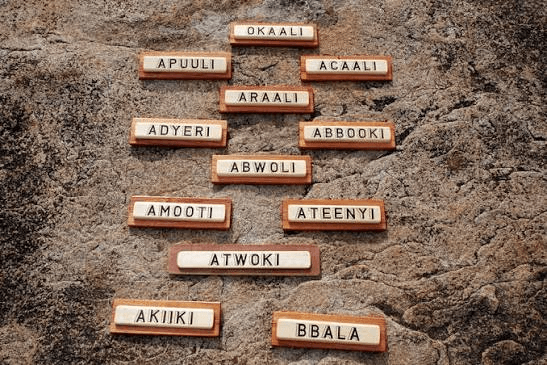
There are twelve Empaako names, including: Akiiki, Abooki, Abwoli, Acaali, Adyeri, Apuuli, Araali, Ateenyi, Atwoki, Amooti, Abbala/Bbala and Okaali.
There are variations in spelling and in how particular names are presented across sources and communities, reflecting differences in orthography, pronunciation and cultural transmission. UNESCO’s documentation describes twelve shared names, while local cultural sources commonly list eleven names used among ordinary community members, with Okaali having a special royal association and reserved for the Omukama (king). (Local cultural accounts also identify Amooti as the official Empaako of the Omukama and Okaali as a special royal form associated exclusively with the monarch.)
The names themselves are therefore not merely labels. They are part of a cultural system with its own rules, history and social meanings.
The Empaako Naming Ceremony
Perhaps nowhere is the cultural depth of Empaako more visible than in the naming ceremony.
Traditionally, the ceremony takes place within the home and involves members of the extended family and the clan, with the clan head presiding over the ceremony, while paternal aunts play an important role in receiving and examining the newborn. They look for characteristics or resemblances that may connect the child to existing members of the family. The clan head then formally declares the child’s Empaako.
The ceremony is therefore not simply about choosing a name. It is an act of introducing a child into a community of memory. The newborn enters the world as an individual, but the ceremony reminds everyone present that this new life is connected to parents, grandparents, ancestors, clans and generations yet to come.
Traditionally, the ceremony also involves a communal meal, gifts and the planting of a tree in honour of the child, usually, with this as a meal the community staple food; millet and smoked beef.
The symbolism is powerful.
A child receives a name.
The community gathers.
Food is shared.
A tree takes root.
In this way, identity, community and nature become part of one cultural moment.
Empaako and the Wisdom of Elders
The tradition also demonstrates the importance of elders and extended family in preserving cultural knowledge.
In contemporary societies, naming is often treated as a private decision made by parents. Traditionally, however, Empaako connected naming to a broader network of cultural custodians.
A child’s identity could be discussed and interpreted by relatives who possessed knowledge of family history, clan relationships and cultural conventions. The involvement of paternal aunts and the clan head illustrates how cultural knowledge was transmitted through participation rather than through written manuals.
This is one of the reasons cultural documentation matters today.
When an elder passes away without transmitting their knowledge, a library can disappear without a single book being burned.
Empaako reminds us that human beings themselves are repositories of history.
Their memories, stories, pronunciation, explanations and experiences constitute an archive that must be valued and preserved.
Empaako as a Language of Respect
One of the most remarkable aspects of Empaako is its everyday use.
It is not confined to museums, royal ceremonies or cultural festivals. It lives in ordinary conversations.
A greeting using Empaako can immediately establish warmth and recognition. A child may use it when addressing a parent. Friends may use it with one another. An individual may use it when speaking respectfully to an elder.
This gives Empaako an important social function.
It can create intimacy without eliminating respect.
It can express familiarity without becoming disrespectful.
It can acknowledge social bonds without requiring a long explanation.
In this sense, Empaako is a social technology developed by generations of cultural experience—a simple linguistic practice capable of carrying complex social meanings.
Research on Empaako has similarly emphasized its sociolinguistic role in expressing intimacy, endearment and respect.
Empaako as an Instrument of Peace
There is another lesson hidden within the tradition.
When societies become divided, language can either deepen the division or help repair relationships.
Empaako has historically offered a culturally meaningful way of addressing another person with respect and affection. UNESCO specifically notes its ability to help defuse anger and communicate unity, peace and reconciliation.
Imagine two people in disagreement.
One approaches the other and speaks using a form of address that recalls their shared humanity and cultural relationship.
The language itself becomes an invitation to reconnect.
This is particularly relevant today. Across Africa, communities are confronting political polarization, generational tensions, cultural change and the pressures of rapid modernization. Traditional systems that encourage respect, dialogue and social cohesion therefore deserve serious attention—not simply as relics of the past, but as potential sources of contemporary wisdom.
Greater Kitara: A Cultural Landscape, Not Just a Historical Kingdom
To appreciate Empaako fully, it must be understood within the broader cultural landscape of Greater Kitara.
The history of Kitara is associated with a complex world of kingdoms, clans, migration, language, oral traditions, spiritual beliefs and systems of governance. Its cultural influence extends beyond the boundaries of a modern administrative map.
Empaako belongs to this larger cultural ecosystem.
It connects language to history, family to clan, individual identity to community and contemporary life to ancestral memory.
That makes Empaako particularly valuable for cultural research.
Studying the tradition is not simply about recording a list of names. It involves exploring the history of the names, their pronunciation, their use in different contexts, their relationship with clan structures, the role of elders, the ceremonies surrounding naming and the ways younger generations understand the tradition today.
Every Empaako therefore has a story behind it—and collectively, those stories form part of the cultural memory of Greater Kitara.
A Tradition Under Pressure
Yet traditions survive only when they are transmitted.
UNESCO has warned that the transmission of Empaako through traditional naming ceremonies has declined significantly, citing declining appreciation of traditional culture and diminishing use of the associated languages as important factors.
Contemporary life presents new challenges.
Urbanization has changed family structures. Migration separates young people from elders. Global languages increasingly dominate education, business and digital communication. Christian and Islamic naming traditions, as well as Western naming conventions, have also influenced personal naming practices.
Research published on Empaako similarly observes that some Banyoro and Batooro families have increasingly adopted European-style naming patterns, although Empaako continues to survive as a form of address expressing respect and intimacy.
The challenge, therefore, is not to reject modernity.
The challenge is to ensure that modernity does not require cultural amnesia.
A young Munyoro should be able to use a smartphone, speak English, participate in a global economy and still know the history and significance of their Empaako.
Cultural preservation should not mean freezing people in the past. It should mean giving communities the freedom and knowledge to carry their heritage confidently into the future.
From Oral Tradition to Digital Heritage
This is where cultural research, documentation and dissemination become especially important.
The Empaako tradition can be preserved through oral-history projects, interviews with elders, audio recordings, photography, documentary films, academic research, school materials, digital archives and community exhibitions.
Imagine a digital Empaako Heritage Archive in which young people can hear elders pronounce each Empaako correctly, learn about its history, watch traditional naming ceremonies, explore clan histories and listen to stories about how the names were used in everyday life.
Such an archive would not replace living culture.
It would support it.
Technology can become a bridge between generations rather than a force that separates them.
Schools could introduce children to local naming traditions. Universities could conduct linguistic and anthropological research. Cultural institutions could organize exhibitions. Communities could record the memories of elders. Diaspora communities could reconnect with traditions that may otherwise become distant.
In this way, digital technology can become an instrument for cultural continuity.
Empaako and the Future of African Identity
There is also a larger African story embedded in Empaako.
Across the continent, communities are increasingly asking how they can participate fully in the modern world without losing the cultural foundations that give their societies meaning.
The answer cannot be found in rejecting modernity or romanticizing the past.
It lies in creating a future where African knowledge, languages, values and cultural systems are treated as assets.
Empaako offers a powerful example.
A simple name can carry history.
A greeting can carry respect.
A ceremony can carry collective memory.
A language can carry an entire worldview.
And a cultural tradition can become a foundation upon which younger generations build new forms of identity, creativity and development.
The Responsibility of a New Generation
The future of Empaako ultimately rests not only with cultural institutions or traditional leaders, but with families and young people.
Parents can teach children their Empaako.
Grandparents can tell the stories behind names.
Schools can create spaces for cultural learning.
Researchers can document oral histories.
Artists can interpret Empaako through music, film, theatre and visual art.
Technology innovators can create digital archives and educational platforms.
Cultural organizations can facilitate intergenerational dialogues.
And governments and cultural institutions can strengthen policies and programmes that support the safeguarding of intangible heritage.
Preservation becomes meaningful when culture remains lived, spoken and practised.
A tradition kept only inside an archive is preserved.
A tradition spoken by children, used by families and celebrated by communities is alive.
Empaako: A Legacy Worth Carrying
Empaako is ultimately a story about belonging.
It tells us that identity is not created by an individual alone. It is inherited, negotiated and continually renewed through relationships with family, community, history and place.
In a rapidly changing world, that message is increasingly important.
The people of Greater Kitara have inherited a cultural tradition in which a name can become a greeting, a greeting can become an expression of respect, and respect can become a foundation for peace and belonging.
That is why Empaako deserves more than occasional celebration.
It deserves research, documentation, teaching, practice and transmission.
It deserves to be recorded in the voices of elders and heard in the voices of children.
It deserves to be studied by scholars, celebrated by artists and embraced by a new generation.
And above all, it deserves to remain what it has always been: a living expression of the relationships that bind people together.
As Africa looks toward a future shaped by innovation, globalization and rapid social transformation, traditions such as Empaako remind us that progress does not require us to abandon where we come from.
Sometimes, the path to the future begins by remembering the name by which our people have always called us.
Kabalega Foundation recognizes cultural heritage as an essential component of identity, community resilience and sustainable development. Through its Cultural Research, Documentation and Dissemination Programme, the Foundation seeks to support the preservation of oral traditions, indigenous knowledge, historical narratives, languages and other forms of tangible and intangible heritage.
The Foundation believes that documenting the cultural heritage of Greater Kitara is not simply an exercise in preserving the past. It is an investment in the future—ensuring that generations to come can understand their history, value their identity and draw inspiration from the knowledge and traditions of those who came before them.

All Categories
- 100 Years of Kabalega
- Advocacy
- African Proverbs
- Annual Events
- Archives
- Blog
- Board of Directors
- Community Empowerment
- Culture
- Education
- Environment
- Events
- Galleries
- Initiatives
- Kabalega Cultural Square
- Kabalega Tourism Trail
- Latest News
- Membership
- Omukama Kabalega
- Opportunities
- Our Executive Team
- Programmes
- Projects
- Social Livelihood Improvement
Recent Posts
Join us to keep Omukama Cwa II Kabalega's legacy alive.
+256-200-900935
info@kabalegafoundation.org