
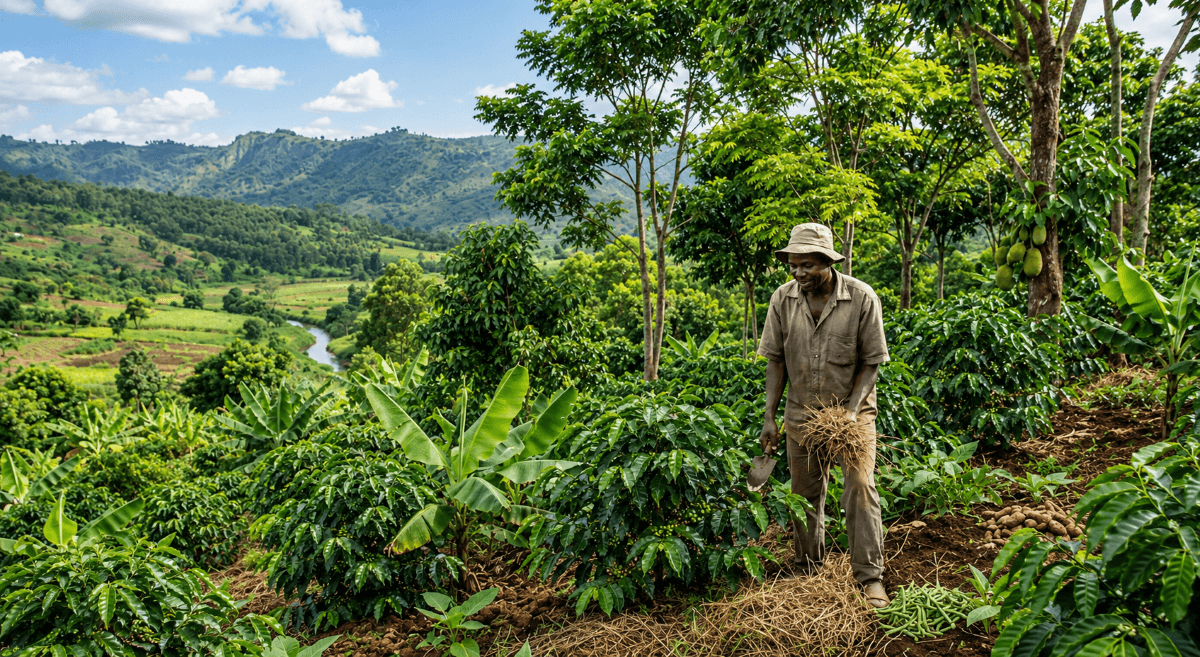
Cultivating Resilience: Promoting Agro-Ecology for Landscape Restoration and Livelihood Enhancement
Across Sub-Saharan Africa and particularly in East Africa, rural landscapes face severe ecological pressure that directly threatens community survival. Unlike regions dominated by large-scale industrial monocropping, land degradation here is driven by intense subsistence pressures: rapid population growth forces continuous forest clearing for food production and settlement, while heavy reliance on biomass fuels widespread deforestation and charcoal commercialization. These practices strip critical canopy cover, exhaust fragile topsoil, and leave rural households dangerously vulnerable to climate extremes like prolonged droughts and erratic rainfall. To break this destructive cycle, communities are turning to agro-ecology—a proven, accessible framework that leverages natural ecosystems to regenerate degraded soils, protect forests, and build lasting financial independence for smallholder families.
These practices strip the natural tree canopy, exhaust topsoil nutrients, and leave rural smallholder farmers highly vulnerable to climate shocks like prolonged droughts and erratic rainfall. To break this cycle of constant land clearing and soil exhaustion, farming communities are turning to agro-ecology—a framework that builds resilient, self-sustaining food systems capable of restoring degraded land without requiring expensive chemical inputs.
What Makes Agro-Ecology Different?
Agro-ecology treats agricultural land as a living, integrated ecosystem. Instead of relying on shifting cultivation—where forests are slashed and burned to find fertile soil—agro-ecology focuses on regenerating the land farmers already have.
-
Agroforestry & Canopy Restoration: Integrating shade trees, fruit species, and fast-growing woodlots directly into agricultural fields. This replaces lost tree cover, provides a sustainable source of firewood (reducing pressure on natural forests), and creates protective microclimates for cash crops like coffee.
-
Soil Regeneration: Keeping the ground covered through organic composting, mulching, and planting cover crops. This restores soil biology and traps moisture, halting the severe topsoil erosion common in cleared, hilly terrains.
-
Biodiversity & Seed Sovereignty: Relying on intercropping and locally adapted native seed varieties that are naturally resilient to East African weather extremes and local pest outbreaks, rather than uniform, imported seeds.
Key Benefits to Rural Communities
Adopting agro-ecological methods delivers direct economic and environmental dividends to smallholder households who cannot afford synthetic fertilizers or large-scale irrigation:
| Challenge Area | Current Degradation Cycle | Agro-Ecological Model |
| Land Use | Continuous clearing of forests for new fertile soil | Regenerates existing farmland, halting deforestation |
| Energy & Fuel | reliance on cutting natural forests for firewood and charcoal | On-farm woodlots and multi-purpose trees provide sustainable household fuel |
| Water Retention | Bare soils lead to rapid runoff, erosion, and drought stress | High organic matter acts as a sponge, storing groundwater during dry spells |
| Income Stability | High risk tied to seasonal weather shocks and single-crop failure | Diversified income from interplanted fruit, shade trees, and secondary crops |
How Communities Can Transition to Agro-Ecology
A transition to agro-ecology is highly accessible for subsistence farmers because it relies on local resources rather than capital. Communities can adopt sustainable practices progressively:
-
Integrate Agroforestry & Shade Trees: Plant multipurpose trees along farm boundaries and interplant canopy trees into main crop fields (like coffee plots) to create protective shade and generate secondary income.
-
Shift to Organic Soil Nutrition: Build simple on-farm compost setups using agricultural waste, animal manure, and leaf litter to enrich the soil naturally, eliminating the need to clear new land.
-
Protect the Soil Surface: Practice continuous mulching and cover cropping to suppress weeds and prevent topsoil from washing away during heavy seasonal rains.
-
Establish Community Seed Banks: Save, exchange, and propagate native crop varieties that withstand local drought conditions better than commercial hybrids.
Institutional Action: The Kabalega Foundation
While agro-ecology begins at the farm level, institutional support is vital to scale these practices across regions. The Kabalega Foundation champions this transition through its Environmental Protection Programme.
Guided by a commitment to sustainable community transformation, the Kabalega Foundation integrates agro-ecology into its core environmental drive to protect ecosystems and build climate-resilient livelihoods. The Foundation drives direct mass seedling distributions—placing indigenous, shade, and fruit trees directly into smallholder hands. Utilizing strategic advocacy platforms like the annual Kabalega Independence Week (KIW) Expo and International Coffee Day, the Foundation sensitizes farmers on the economic benefits of shade-grown coffee and sustainable land management. These efforts are sustained year-round through community-led planting networks involving local farmer groups, schools, and civic institutions.
A Shared Responsibility for Generations to Come
Protecting our natural environment is both a modern necessity and a cultural duty. By embracing agro-ecology, restoring tree canopy cover, and adopting climate-resilient farming techniques, smallholders across Uganda are turning degraded landscapes back into productive, self-sustaining ecosystems.
The Kabalega Foundation remains dedicated to standing alongside farmers, institutions, and conservation partners to plant, protect, and build a greener, climate-resilient future.

All Categories
- 100 Years of Kabalega
- Advocacy
- African Proverbs
- Agriculture & Agribusiness
- Annual Events
- Archives
- Blog
- Board of Directors
- Community Empowerment
- Culture
- Education
- Environment
- Events
- Galleries
- Initiatives
- Kabalega Cultural Square
- Kabalega Tourism Trail
- KIW
- KIW2026
- Latest News
- Membership
- Omukama Kabalega
- Opportunities
- Our Executive Team
- Programmes
- Projects
- Social Livelihood Improvement
- Sports & Wellness
Recent Posts


Join us to keep Omukama Cwa II Kabalega's legacy alive.
+256-200-900935
info@kabalegafoundation.org